
If cheaper cognition means more cognition, what exactly is the unit of work that becomes more abundant, and is there a level of it that stays ours?
If you haven't read it, “The Cognitive Revolution” gives us a historical frame for what AI may represent. In short it says that while the Industrial Revolution transferred much of human physical labor to machines, AI may now be doing the same thing to cognitive labor. Put differently, as the cost of cognition falls, we should expect demand for cognition to rise. We will analyze more, model more, write more, diagnose more, and ultimately create far more cognitive output than humans alone ever could.
That may be directionally right. But the analogy also hides the most interesting question. What exactly is the unit of work that becomes more abundant? If we assume it is analysis, the logic is straightforward: cheaper analysis produces more analysis, just as spreadsheets created more financial modeling rather than eliminating it. But AI may be different because its promise is not simply to automate analysis. It can increasingly decide what analysis matters, discover patterns we did not think to look for, suggest the next question, and eventually act on the answer. If that is true, the cognitive revolution is not just about doing more work at a lower cost. It is about AI moving up the stack of cognition itself.
The moving frontier
It helps to imagine cognition as a pyramid. At the bottom are tasks such as retrieval, calculation, classification, summarization, and routine analysis. Above that sit interpretation, insight, synthesis, and question formation. Higher still are judgment, decision-making, goal setting, taste, and the definition of what is valuable in the first place.
At first, AI clearly validates Buhler's thesis. It removes the cost of lower-level cognitive work and allows humans to spend more time on higher-level work. Instead of manually producing a cross-tab, we can interrogate the data. Instead of spending days gathering background on a medical topic, we can begin with a sophisticated map of the field and ask better questions. Our starting point is higher, and the cost of curiosity is lower.
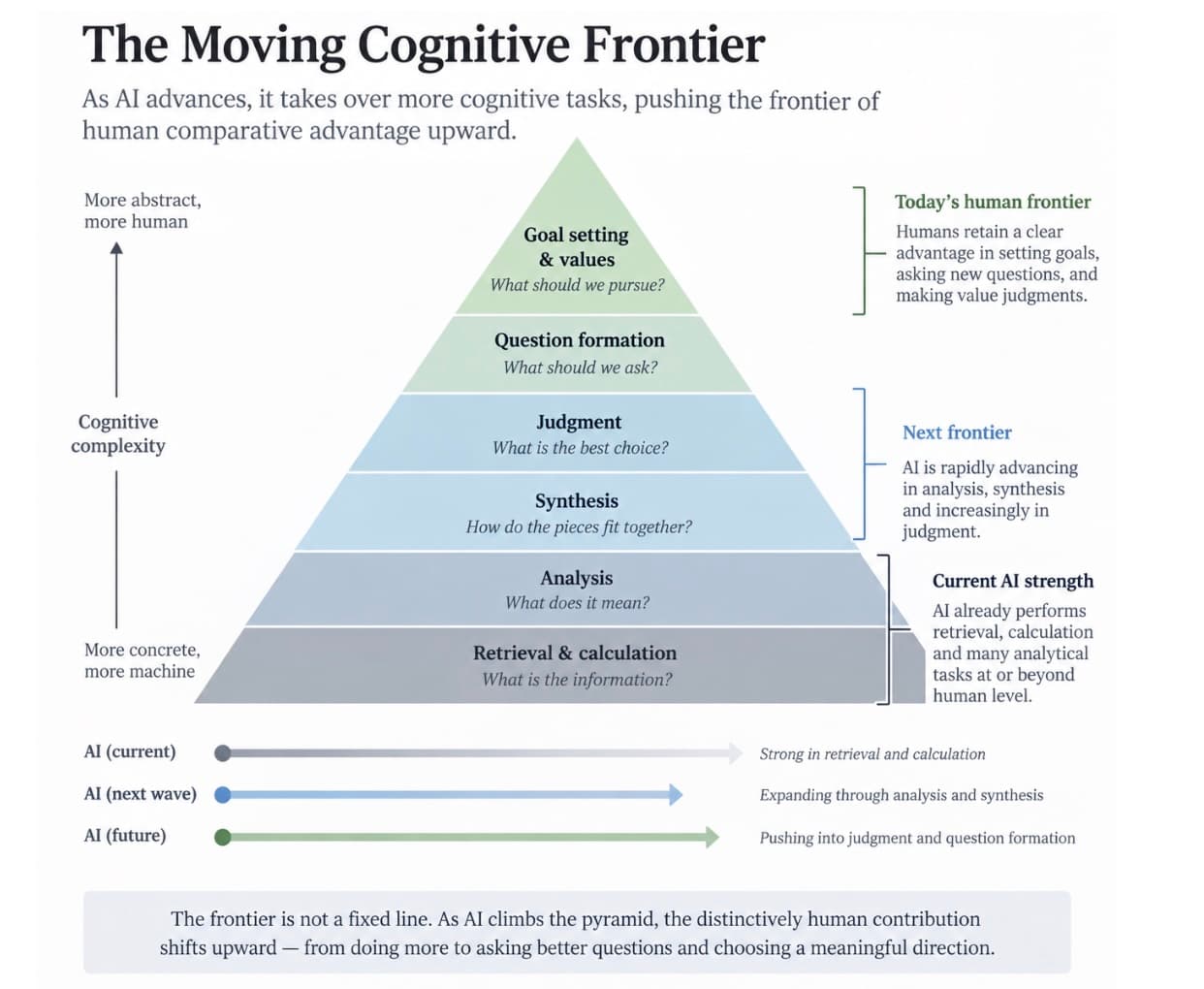
The problem is that the frontier does not stay still. AI is already moving from answering questions to proposing them, from analysis to interpretation, from drafting options to recommending actions. The human response is to move upward. But AI moves upward too. The traditional labor-transition story assumes that when technology automates one layer, people learn a new skill and occupy the next layer. The cognitive revolution raises a harder possibility: what if the machine keeps climbing the same staircase? And why wouldn't it?
That does not mean necessarily human work disappears. It means we should be cautious about describing the transition as simply a move to a new skill set. The scarce human contribution may migrate repeatedly: from analysis to synthesis, from synthesis to judgment, from judgment to goal setting, from goal setting perhaps to values, accountability, trust, or desire itself. The question is not only whether new roles appear, but whether there is a durable frontier at which human comparative advantage stabilizes.
More cognition, or less need to think?
There is a second tension. Buhler's thesis assumes that abundant machine cognition expands the amount of cognition society consumes. That is plausible at the system level. Machines may perform orders of magnitude more reasoning, analysis, simulation, and experimentation than people ever could. But that does not necessarily mean humans themselves will think more.
AI creates two possible equilibria. In an exploration equilibrium, it makes thinking more rewarding. Because the entry cost to a subject collapses, people can explore areas that were previously inaccessible. A person who knows little about medicine, economics, law, or engineering can begin a meaningful inquiry in minutes. Each answer becomes a platform for a better question. Curiosity compounds. The user is not simply outsourcing thought; AI is extending the range of questions the user is capable of asking.
But there is also a dependency equilibrium. If the system is consistently better at finding the pattern, framing the question, evaluating the options, and recommending the next move, the incentive to build those abilities ourselves may decline. Why struggle through a difficult text if the model can explain it? Why learn how to structure an analysis if the system can produce one instantly? Why hold a complex map of a field in memory if an agent can retrieve and connect it on demand?
This is not primarily an argument about intelligence. It is an argument about incentives. Human cognitive capability is partly produced by practice. Reading, calculating, writing, arguing, remembering, and struggling with ambiguity are not just methods for producing an output; they are processes through which judgment is built. If AI supplies the output while removing too much of the process, cognitive output could rise while human cognitive development weakens.
Education is the test case
Education makes the trade-off impossible to ignore. Consider an elementary or middle-school student. If AI can write the paragraph, solve the equation, summarize the chapter, and explain the historical event, the narrow productivity argument says the student should use it. But education has never been primarily about maximizing the efficiency of producing correct answers. The work is formative. We ask children to do things inefficiently because doing them changes the person who is doing them.
That does not imply that AI should be excluded from education. The opposite may be true. Used well, it could dramatically raise the level at which students can explore. A child can ask follow-up questions without embarrassment, test an idea immediately, move across disciplines, receive personalized explanations, and reach conceptual territory that would otherwise be years away. AI can compress the climb.
The design question, then, is not simply “How do we use AI in school?” It is: which cognitive experiences are developmental and therefore should not be optimized away? We may need to distinguish between cognition as production and cognition as formation. The first is about obtaining the best answer. The second is about developing the mind capable of recognizing, challenging, and using that answer.
A different way to read the cognitive revolution
This suggests a modification to Buhler's argument rather than a rejection of it. He may be right that machine cognition will explode and that cheaper intelligence will generate far more cognitive activity across the economy. But that tells us less about the future of human work than it first appears to. The important variable is not simply the quantity of cognition. It is how cognitive labor is divided between humans and machines, and what that division does to human capability and motivation over time.
The central question may therefore be: does AI increase or erode our incentive to think? The answer will differ by person, institution, and use case. For some, AI will be an intellectual exoskeleton. It will let them start higher, move faster, make connections they could not previously see, and ask increasingly ambitious questions. For others, it may become a cognitive autopilot that gradually removes the need to understand what happens beneath the interface.
That distinction has consequences far beyond productivity. It shapes how we should design education, organizations, professional development, and AI products themselves. If the only objective is to maximize output, we will automate as much of the cognitive pyramid as possible. If we also care about maintaining human judgment, curiosity, independence, and the ability to set worthwhile goals, then some friction may be valuable.
Closing
The real question of the cognitive revolution is therefore not whether machines will think more. They almost certainly will. The question is whether abundant machine intelligence expands the frontier of human thought, or gradually reduces the need, and eventually the incentive, for humans to reach that frontier themselves.
The optimistic future is not one in which humans preserve some protected category of higher-order cognition that machines can never touch. That frontier is likely to keep moving. It is one in which every time AI raises our starting point, we use that advantage to ask better questions, make richer connections, and pursue ambitions that were previously beyond us.
But there is a deeper reason this matters. Cognition is not only a productive input. The process of understanding, questioning, and forming judgment is part of what gives people agency: the ability to decide what matters, to challenge the answer they are given, and to choose rather than merely accept an optimized recommendation.
AI may therefore do two things at once. It can raise the ceiling of what humans are capable of understanding and accomplishing. And, if we increasingly delegate the cognitive processes through which judgment is formed, it can also remove the ladder by which we learn to reach that ceiling.
The challenge of the cognitive revolution is not to keep humans doing work that machines can do better. It is to ensure that as machines become more capable of thinking for us, humans remain capable, and motivated, to think with them, beyond them, and when necessary, against them.
Questions by Vas. Written by ChatGPT.